
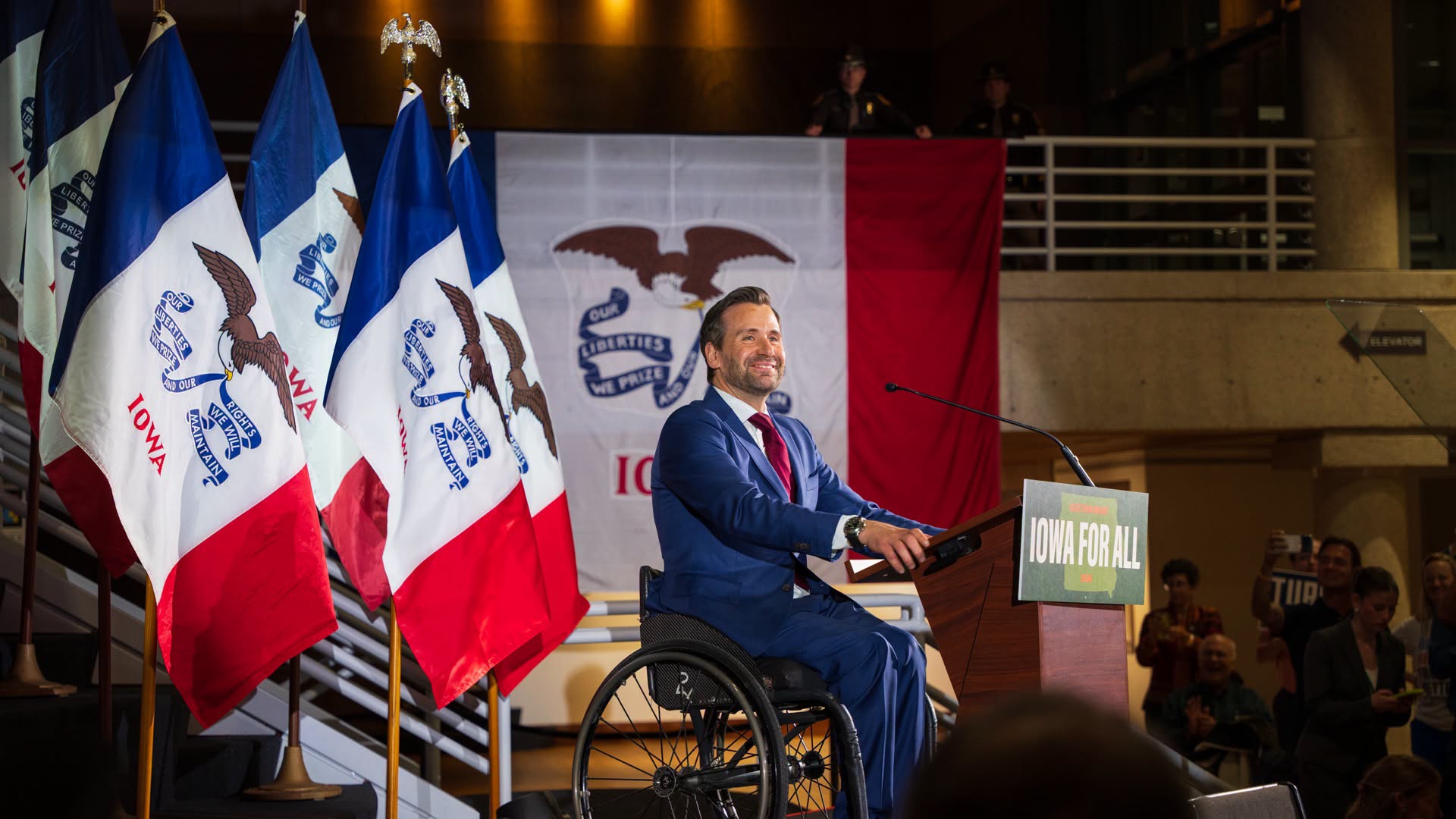
First in a series interpreting the results of Iowa’s 2026 state and federal elections. This post first appeared on the Iowa politics with Laura Belin newsletter, where Laura publishes weekly summaries of her radio show, “KHOI’s Capitol Week.” The 30-minute program is also available through all podcast platforms.
It’s been quite the week. I woke up on election day to see the New York Times had published Erik Wemple’s story about my years-long battle for access while covering state government. Here is a gift link. Erik’s research and attention to detail were remarkable—though it was strange to have a reporter following me around for a couple of days!
Erik’s article opens with Governor Kim Reynolds’ press secretary closing the door on me in January. Knowing a community has my back has gotten me through many frustrating days, and I will always be grateful to those who reached out then. When I told Danya Issawi my readers are supportive and even protective, that’s what I had in mind. Danya interviewed me recently for a Substack series on local news writers.
I was out late Tuesday night at the Democrats’ main victory party in Des Moines. Spencer Dirks and I were on the air early Wednesday to break down the election that ended the Iowa Republican trifecta and transformed our Congressional delegation from six Republicans and zero Democrats to a 4-2 Democratic split.
The sound file for our November 4 show (a special 60-minute edition) is available through all podcast platforms. Here’s a detailed summary, for those who would rather read than listen.
A huge win for Rob Sand
Although State Auditor Rob Sand led Republican nominee Zach Lahn in every public poll since the primary, I expected the governor’s race to be close. I thought the few polls showing Sand ahead by 10 or 12 points had to be missing a lot of MAGA voters.
Wrong. Unofficial results show Sand and Dave Muhlbauer received 757,326 votes to 607,415 for Lahn and Derek Wulf (55.4 percent to 44.5 percent). If anything, most polls underestimated the Democrat’s lead.
How did Sand win statewide by 150,000 votes when the GOP’s voter registration advantage is still around 165,000? There was no “one neat trick”—he must have had a perfect storm of high Democratic and no-party turnout, a commanding lead among independents, and a lot of crossover votes.
It will take time to sort through the county-level data, and more will become clear when turnout reports are released in a few weeks. For this show, I wanted to highlight how dominant Sand was.
Sand had big margins in large counties
We started with Polk County. Democrats almost always win here, but the margin matters a lot. In 2018, Fred Hubbell came out of Polk County with a lead of about 38,000 votes (roughly 58 percent to 40 percent). He lost statewide by around 36,000 votes (50.3 percent to 47.5 percent).
Polk County usually is one of the first to report, and when I saw Sand’s lead was approaching 75,000 votes, I could hardly believe it. He received 67 percent of the vote in the county to just under 33 percent for Lahn.
It’s clear from results in other races that the coordinated campaign, Polk County Democrats, and neighborhood groups smashed the GOTV. I don’t know whether GOP turnout was down, or whether there were a ton of “Rob-publicans” in the Des Moines metro, or both. The turnout report will give us more clues.
Statewide, 1,366,516 Iowans voted for a candidate for governor. That was a little higher than the 2018 turnout (1.33 million) and much higher than 2022 (1.23 million votes for a candidate for governor). I suspect that Democratic and no party turnout will turn out to be substantially higher than 2018 and GOP turnout lower.
Sand’s margins in other large counties were eye-popping:
- Linn County (Cedar Rapids metro): 65.6 percent to 34.3 percent
- Scott County (Quad Cities): 58.3 percent to 41.6 percent
- Johnson County (Iowa City area): 78.6 percent to 21.3 percent
- Story County (Ames area): 67.2 percent to 32.7 percent
- Black Hawk County (Waterloo/Cedar Falls): 63.3 percent to 36.6 percent
- Dubuque County, which voted for Donald Trump three times: 56.5 percent to 43.4 percent
- Dallas County (far western suburbs of Des Moines): 59.4 percent to 40.5 percent
Sand narrowly won Woodbury County (Sioux City area), which rarely votes for Democratic candidates, by 51.0 percent to 48.9 percent. He was only a fraction of a point behind Lahn in Pottawattamie County (Council Bluffs area).
Sand reclaimed many mid-sized counties
By my count Sand carried 25 of the 99 counties. Hubbell carried just eleven in 2018.
Longtime readers know of my low-key obsession with the mid-sized cities, also known as micropolitan areas with populations between 10,000 and 30,000. Eleven counties containing those cities used to be reliably Democratic, but mostly stopped voting for Democrats in the mid-2010s.
Sand carried nine of those counties: Boone, Cerro Gordo (Mason City area), Clinton, Des Moines (Burlington area), Jasper (Newton area), Lee (Keokuk and Fort Madison), Muscatine, Marshall, and Warren (Indianola). He was just one vote behind Lahn in Wapello County (Ottumwa area). He fell short in Webster County (Fort Dodge), but still managed 48 percent of the vote there.
Hubbell had carried only three of those counties (Des Moines, Lee, and Clinton, where his running mate Rita Hart was a two-term state senator).
Winneshiek County (containing Decorah) voted for its native son by an 18-point margin, and Sand won several other northeast Iowa counties: Bremer, Buchanan, Cedar, Tama, and Poweshiek. In the southeast, he carried Jefferson County (containing the unique town of Fairfield), which was the only rural county to vote for Hubbell.
Winner promises to work for all Iowans
At his victory party in Des Moines, Sand didn’t spike the football. He emphasized a central theme of his town halls: divided government would ensure that leaders focus on policies most can agree on. “Tonight, Iowans sent a clear message: they want government not to work for a few insiders or special interests or for one party, but for all Iowans.”
The winner made several gestures toward finding common ground. He had the whole room sing the first verse of “America the Beautiful” (a staple of his town halls). He urged supporters to talk to their neighbors, especially people who didn’t vote the same way, and try to find something they agree on.
He told Iowans who hadn’t voted for him, “You are going to see me out and about. I hope that you stop me, and I hope you introduce yourself, and I hope you kindly tell me why you didn’t vote for me.” He urged them to keep an open mind as they got to know him better.
Sand also had a message for Republican legislators who maintained their Iowa House and Senate majorities: “I look forward to working with you on the same common sense ideas and solutions that we advocated for throughout this campaign.” He promised that anyone who votes for a bill will be invited to the signing ceremony. (Governors Terry Branstad and Kim Reynolds took an exclusionary approach, usually inviting only Republicans even when signing bipartisan bills.)
C-SPAN posted video of Sand’s full remarks from Tuesday night.
Republicans vow to continue the fight
In his concession speech (which you can watch on C-SPAN), Zach Lahn said the fight to preserve “our culture” is “just beginning right now.” He urged legislators to “fight to protect this state” and predicted this election would be seen as the beginning of a movement against career politicians, corporate interests, and lobbyists.
Some have speculated that Lahn will return to Kansas to be with his children who live there. But he told supporters at the Republican event that he would continue the fight “in the state of Iowa” and closed with, “To the people of Iowa, we’ll see you in four years.”
A lot can change in a few years; after Kim Reynolds’ landslide re-election in 2022, I wouldn’t have believed a Democrat could win the next governor’s race, let alone by double digits. Given the scale of the blue wave across the country, I think a Republican who lost narrowly could say look, it was a tough year. On the other hand, I struggle to see Lahn as a viable candidate for governor in four years after losing to Sand by this kind of margin.
Republican Party of Iowa chair Jeff Kaufmann was far from gracious in a statement: “Rob Sand’s victory does not give him a blank check. He spent this campaign trying to sell Iowans a different version of himself, claiming he would put Iowans ahead of his political party. Now he’ll have to prove it.”
Kaufmann added, “If he pursues the outrageous policies Democrats have been pushing, Republicans in the Legislature must stand firm and fight back every step of the way. We will have their backs.”
Sand couldn’t be more clear about pursuing a unifying agenda. Sometimes governors who work with legislatures controlled by the other party (Democrats in Kansas and Kentucky, Republicans in Vermont or Maryland) can be very popular. They can’t enact far-left or far-right policies, so many bills they sign have broad appeal.
First thoughts on Turek’s victory
Josh Turek became the first Democrat to win a U.S. Senate seat in Iowa since Tom Harkin secured his fifth term in 2008. While his race was closer than the governor’s race, Turek still won by a solid margin: 686,486 votes to 630,615 for Ashley Hinson (50.5 percent to 46.3 percent). The Libertarian Thomas Laehn received 42,052 votes (3.1 percent).
Again, polls did not underestimate the Republican: most polls saw only a point or two separating Turek and Hinson. I was skeptical about the few surveys that showed Turek ahead by four, but those turned out to be accurate.
When we discussed the Senate race on this show, I’ve often mentioned that a Libertarian on the ballot created a path for Turek to win with less than 50 percent of the vote. I never thought he might get than 50 percent against Hinson, a solid candidate.
In a wave election, we’ve often seen most battleground U.S. Senate races go the same way: for Republicans in 1980, 2010, and 2014, and for Democrats in 2006. This year Democrats will pick up at least seven U.S. Senate seats, and Iowa was part of the trend.
As expected, Turek didn’t win as many counties as Sand did in the governor’s race. In a red-leaning state, it’s easier for a Democrat to win a state office than a federal office. I’ll be digging into the county-level data more this weekend. By my count, Turek carried fourteen counties. His margins in the biggest counties were large: he received 62 percent of the vote in Polk, 60.7 percent in Linn (where Hinson worked as a TV reporter and anchor for a decade), 54.5 percent in Scott, 75 percent in Johnson, 58 percent in Black Hawk, and 62.5 percent percent in Story. He won Dallas County by almost 11 points.
Turek flipped several former Democratic strongholds that have voted red during the Trump era: Dubuque (which Hinson carried in her last two Congressional races), Cerro Gordo (Mason City), Des Moines (Burlington area), Marshall (Marshalltown), and Muscatine. He also carried Jefferson County.
He carried his home county of Pottawattamie by a small margin (48.5 percent to 48.2 percent), which is incredible. Very few Democrats have done that. He only lost Woodbury County by a couple of points.
Turek: “We have proven that the impossible was possible”
During his victory speech (which you can watch in full here), Turek acknowledged he went into the Senate race as an underdog and listed several other times when he had accomplished what others had called impossible. He said “our campaign finance system is broken” but celebrated that Iowans “out-voted the billionaires.”
As a senator, Turek promised, he would fight to end the war in Iran and Trump’s “chaotic tariffs.” He said he would also fight for livable wages, affordable housing, and accessible health care, “because I believe that health care is a human right,” and a part of that human right is also women’s reproductive freedom.” He pledged to address other problems, including Iowa’s cancer crisis, poor water quality, and the “corruption” on both sides of the aisle in Washington, D.C.
“A dream come true” for Tom Harkin
Turek invited his mentor, former Senator Tom Harkin, to join him on stage at the victory party. He said the architect of the Americans with Disabilities Act “changed my life and gave me and so many other Americans an on-ramp onto society. Had it not been for this man, who represents the epitome of what is good and what is good in public service, my life would have looked very, very different.” (For my money, the ADA is the most significant legislative accomplishment by a first-term senator in U.S. history.)
I caught up with Harkin later that evening, and he told me seeing Turek win his former Senate seat was “a dream come true”: “It’s living long enough to be able to see what the Americans with Disabilities Act actually means.” Turek showed that “the barriers are down,” and he will be “an example to a lot of people with disabilities” that they can follow their own dreams, Harkin said.
I asked the former senator what committees Turek should try to serve on. Harkin would like to see Turek on the Senate Appropriations Committee and on HELP (Health, Education, Labor and Pensions), probably also the Agriculture Committee. Having served with some of the current Democratic senators, Harkin told me he’s doing all he can to help Turek land a seat on Appropriations. That committee can do a lot of good for Iowa—not necessarily “big splashy things,” but funding that makes a difference.
I also asked Harkin to react to the blue wave sweeping the country. He saw a straightforward message from voters: “No more Trump.”
Christina Bohannan wins on third try in IA-01
Democrats flipped three of Iowa’s four Congressional districts. In the first district, Christina Bohannan won her third race against GOP incumbent Mariannette Miller-Meeks by 182,396 votes to 150,471 (52.7 percent to 43.5 percent).
Bohannan came out of Johnson County (Iowa City area) with about 75 percent of the vote and a raw vote lead of nearly 40,000. She also carried Scott County (Quad Cities area) by almost 13 points, which surprised me. She also carried three of those mid-sized counties: Clinton (barely, by 1 percentage point), Des Moines (about 3.5 points), and Muscatine (about 6.5 points).
Independent candidate Michael Bridgford spent hundreds of thousands of dollars on his campaign, much of it to run commercials on streaming services. He also worked hard, attending events in every corner of the district. He ended up with about 3.6 percent of the vote, not much more than the typical vote share for third-party candidates in Iowa Congressional races. I thought his number would be higher. It goes to show how difficult it is to convince voters to mark their ballot for someone outside the two-party system, even in a district with around 200,000 registered voters not affiliated with either party.
I’m working on deeper dives about all of the House races.
Lindsay James turns IA-02 blue
Way back in December 2025, I told listeners of “KHOI’s Capitol Week” that the 13-point swing in a special U.S. House election in Tennessee “indicates IA-02 is in play.” And ever since State Representative Shannon Lundgren ended her campaign for the GOP nomination, I have been saying that Joe Mitchell—who moved to northeast Iowa days before launching his campaign—was not a good fit for the second district.
When analysts called Kentucky’s sixth Congressional district for Democrats early on Tuesday night, I had a feeling IA-02 would follow the same path. State Representative Lindsay James received 171,484 votes to 157,722 for Mitchell (49.5 percent to 45.5 percent). Libertarian Rick Stewart received about 9,500 votes (2.7 percent) and independent Dave Bushaw received 7,469 votes (2.2 percent).
James carried Linn County by 59 percent to 37 percent, gaining about 23,000 more votes than Mitchell. She also carried Dubuque County, where she has lived since 2015, by about 6.6 points, Black Hawk County by nearly 17 points, and Cerro Gordo and Winneshiek by narrow margins (a little more than 1 point).
The combined vote for the third-party candidates was larger than the differrence between James and Mitchell, but I doubt they played a spoiler role. Stewart probably drew more votes from the Republican, while Bushaw (running on a progressive populist platform centering the working class) may have cut into James’ support. Republicans will certainly target this seat in 2028, and I will be curious to see whether third-party candidates qualify for the ballot again.
Big numbers for Sarah Trone Garriott in IA-03
I’ve been saying all year that U.S. Representative Zach Nunn was in trouble in the third Congressional district, where Trump is unpopular and Democrats have strong GOTV in the largest counties. But Republicans had been talking up Nunn’s internal polling lately, and the incumbent’s closing ads emphasizing bipartisanship seemed effective.
Cindy Axne flipped this district in 2018, winning with less than 50 percent of the vote, thanks to third-party candidates on the ballot. Since no third party qualified this year, I knew State Senator Sarah Trone Garriott would need to improve on Axne’s margin of about 33,000 votes in Polk County. It didn’t take long for Polk to report huge numbers for the Democrat: 60.5 percent to 39 percent, and a raw vote lead of about 46,000.
I knew that would be very hard for the incumbent to overcome. Unofficial results show 189,217 votes for Trone Garriott and 163,441 for Nunn (53.5 percent to 46.2 percent). That’s a big spread for a district that typically has close races.
When Dallas County finally reported—why does it always take them so long?—I saw Trone Garriot netted a few thousand more votes there (52.8 percent to 47.1 percent). She won tough Iowa Senate races in Dallas County in 2022 and 2024, knocking thousands of doors each time.
Nunn carried all of the other counties, but Polk and Dallas accounted for nearly 78 percent of all ballots cast across IA-03. Republicans can’t get blown out in the Des Moines metro and make it up elsewhere.
Chris McGowan wins IA-04, by less than expected
A foregone conclusion: Republican Chris McGowan won the open fourth Congressional district, which includes KHOI’s listening area. But look at the margin: 178,845 votes for McGowan and 123,940 for Dave Dawson (59.0 percent to 40.9 percent). Randy Feenstra won the same district by a 67-33 margin two years ago.
I didn’t have time to dig into all the county numbers before we were on the air. But it is clear that the Democratic GOTV (fueled by eight field offices scattered around the district) was successful. Republican turnout probably didn’t reach the 2018 level. They needed to put up big numbers in the IA-04 counties.
I talked about the headwinds facing the GOP, McGowan’s lackluster campaign, and Dawson’s work ethic in this post from Tuesday: “Why Iowa’s fourth district matters more than you think”
Dawson carried Story County by about a 25-point margin, carried Marshall County, and didn’t lose by much in Woodbury and Pottawattamie counties. You can see across the board that the Democrat was losing the deep-red counties by less than the margins from the 2022 and 2024 elections. Even though Dawson lost, I consider his campaign very successful.
Nate Willems wins attorney general race
Four years ago Brenna Bird was the first Republican to win an attorney general election in Iowa since the 1970s. Iowans cut her tenure short on Tuesday, as Democratic challenger Nate Willems received 681,097 votes to 657,405 for the incumbent (50.8 percent to 49.1 percent). As soon as I saw the Polk County numbers (Willems led by more than 52,000 votes), I knew this race was in play.
The final result was a mirror image of Bird’s victory over long-serving incumbent Tom Miller in 2022 by just over 20,000 votes, a margin of 50.8 percent to 49.1 percent.
I haven’t analyzed all of the data yet, but I suspect Bird underperformed other GOP candidates in some red counties, particularly where landowners have been fighting the Summit Carbon Solutions proposed CO2 pipeline. I explained why the pipeline issue could be a problem for Bird in Tuesday’s post about the fourth Congressional district. Bird gained direct control over Iowa’s Office of Consumer Advocate in 2023, but the office did nothing to help those battling Summit’s use of eminent domain.
More broadly, the little polling we’ve seen over the past year consistently showed Bird had low favorable ratings. Although Bird was able to outspend the challenger on TV and radio ads, her message wasn’t enough to counter the Willems ads slamming Bird for going easy on corporate polluters.
Taylor Wettach wins state auditor race
Before Rob Sand won the state auditor race in 2018, no Democrat had been elected to that office in my lifetime. But Taylor Wettach managed to keep the office in the Democratic column on Tuesday, winning 666,632 votes to 660,159 for Republican Chris Cournoyer (50.2 percent to 49.7 percent).
As close as that was, Wettach’s advantage was about twice as large as Sand’s winning margin in 2022 (just under 3,000 votes amid poor Democratic turnout). A Muscatine native, he carried several Mississippi River counties that voted for Trump three times.
Wettach raised and spent around four times more than Cournoyer, in the range of $2 million to less than half a million dollars for the Republican. Wettach’s TV ad was in heavy rotation in major media markets during the closing weeks, whereas Cournoyer seemed to be advertising only on digital platforms.
Wettach spoke to the camera in his lighthearted ad, introducing himself as a seventh-generation Iowan who grew up bagging groceries at Hy-Vee. He promised to be an “independent watchdog like Rob Sand,” standing up to both parties. He described “the other candidate” (not named) as “a career politician. Who do you want guarding the henhouse?”
Cournoyer didn’t speak in her own spot. A narrator described her as a mom of four who “knows what Iowa families are up against.” The ad noted that she cut taxes in the state Senate and promised she would be a “top taxpayer watchdog” fighting for more tax relief as auditor. It didn’t mention that Cournoyer has served as lieutenant governor since December 2024. Maybe GOP internal polling showed Iowans are ready to move on from Kim Reynolds’ administration.
I would welcome insight on why Republicans didn’t make more of an effort to boost Cournoyer’s campaign. Were they confident she could win without more resources, because of her name recognition and the GOP’s voter registration advantage? Was it payback for endorsing Nikki Haley for president before the 2024 caucuses?
Sand has called for restoring the powers of the auditor’s office and repealing the law Republicans enacted in 2023. Among other things, the law eliminated the auditor’s ability to go to court to enforce subpoenas and made it easier for state agencies to shield documents from auditors.
GOP lawmakers might have been willing to do that if Cournoyer were in a position to investigate a Sand administration. I don’t know that the legislature would do anything to empower Wettach, though.
Republicans hold other statewide offices
Three GOP statewide officials won another term on Tuesday. The closest race was for state treasurer: Roby Smith won 664,948 votes to 655,763 for Democratic challenger John Norwood (50.3 percent to 49.6 percent). That was a low-budget race, and I wonder whether the outcome would have been different if Norwood had the resources for TV ads like Wettach did.
Secretary of State Paul Pate received 711,766 votes, and Democratic challenger Ryan Peterman received 625,867 votes (53.2 percent to 46.8 percent). It sounds like a comfortable margin, but Pate was re-elected by 20 points four years ago.
Secretary of Agriculture Mike Naig won a third term with 701,882 votes to 629,249 for Chris Jones (52.7 percent to 47.2 percent). Naig’s campaign far outspent Jones but the result was much closer than the incumbent’s 22-point victory four years ago.
Jones said in a statement released Tuesday night,
This campaign has been a victory for all Iowans concerned about the state of Iowa’s water.
Iowa is not the same as when we started this campaign in January. When we started, few other candidates were even talking about water quality as an issue. Iowa residents were left to wonder if their government would ever take the issue seriously.
Voters aren’t going to stop demanding that our politicians take serious action on fixing our water pollution. And the movement that powered our campaign will be there to keep holding corporate agricultural polluters accountable.
Although Jones didn’t win, he elevated clean water as a campaign issue and helped force candidates in both parties to address water pollution and its relationship to Iowa’s high cancer rates.
I’m curious to see whether Naig co-opts any of Jones’ ideas in the coming year. Obviously he wouldn’t support more regulations on farm operations, but perhaps he might embrace some other ways to promote local foods.
I also wonder whether Sand will give Jones any role in his administration. He has said addressing water quality will be a priority.
Constitutional amendment passes easily
Iowans approved a constitutional amendment that will require a two-thirds majority to raise income taxes or corporate taxes. It wasn’t close: 686,939 yes votes to 534,258 no votes (56.3 percent to 43.7 percent). I knew it would pass when I saw “no” barely ahead in Polk County.
I’d tried for months to get Sand on the record about this proposed amendment. He told me in July and August that he needed to study the issue further. He told the Des Moines Register’s editorial board in October that he didn’t know how he would vote on it. Finally, during a gaggle before Sand voted on November 3, he explained that he would support the amendment if it only applied to tax increases on “regular working Iowans.” The problem for Sand: the amendment includes corporate taxes and “the absolute wealthiest in the state, and that gives me heartburn. I’m voting no.”
A coalition of labor unions and nonprofit organizations tried to defeat the amendment, but Republican-aligned “tax relief” groups spent much more on positive messaging about it. I wonder if the amendment could have been defeated if Sand had made the case forcefully. Presumably he didn’t want to bring it up, because Lahn’s campaign was running ads accusing him of wanting to raise taxes.
This supermajority requirement applies only to income and corporate taxes. The legislature can increase the sales tax and various user fees by a simple majority vote. They can also cut taxes by a simple majority vote, forcing Sand to either veto tax cuts or approve revenue reductions we can’t afford.
This constitutional amendment poses a serious threat to Sand’s administration. The state budget will crash sometime in the next three to four years. With this language in the state constitution, the only options to balance the budget will be severe cuts to public services or a big increase in the regressive sales tax. Both would be unpopular as Sand heads into a re-election campaign in 2030.
Democrats net one Iowa Senate seat
We covered the notable state legislative election results. I will be writing in more depth about all of these races.
Big picture: the Iowa Senate moves from 32 Republicans, seventeen Democrats, and one vacancy (following the death of Julian Garrett) to 32 Republicans and eighteen Democrats after new members are sworn in.
Democratic State Senator Catelin Drey won a full four-year term in Senate district 1 (Sioux City), which she flipped in an August 2025 special election. It wasn’t close: about 2,500 votes (a 15-point margin) separated her from her opponent. But fellow Democrat Mike Zimmer lost to Joe Stutting by about 1,000 votes (a roughly 52-48 margin) in Senate district 35, which he flipped in a January 2025 special election. That district covers Clinton County and parts of Scott and Jackson counties.
Democrats picked up two Senate seats: Heather Matson won the open Senate district 21, covering most of Ankeny, by nearly 4,500 votes (56.3 percent to 43.6 percent for John Hollingrake). The scale of the victory shocked me, because Ankeny has historically had very close legislative races. And in an upset, Nikhil Wagle defeated first-term Senator Scott Webster in Senate district 47 (Bettendorf), by just 151 votes (50.2 percent to 49.7 percent).
Iowa Senate Minority Leader Janice Weiner said last month on Julie Gammack’s “Iowa Potluck” podcast that Democrats were determined to reach at least eighteen seats, because Sarah Trone Garriott was running for Congress. Trone Garriott will step down from the legislature soon, and Democrats will need to defend Senate district 14 (Dallas County) in a special election. Now, even if they lose that seat, Republicans won’t have a supermajority —which would allow the GOP to override Governor Sand’s vetoes.
Democrats pick up eleven Iowa House seats
The Iowa House will move from a 67-33 Republican majority to 56-44 when the legislature reconvenes in January. No seats were recount-close.
The eleven-seat gain far exceeded most people’s expectations. I thought the ceiling for House Democrats was around 39 seats.
You know it’s a wave election when a party wins legislative races that no one was watching. On Tuesday night, someone asked what I thought about Nick Salazar. I was embarrassed not to recognize the name, even though I closely follow state legislative campaigns. Salazar defeated three-term incumbent Mark Cisneros in House district 96 (Muscatine area) by just under 500 votes (52.0 percent to 47.5 percent).
The other shocking result was in House district 20, Josh Turek’s current seat in Council Bluffs. It was always going to be a tough hold, because Trump carried the district by an 8-point margin in 2024. Democratic candidate Eric Armstrong worked extremely hard, knocking on approximately 17,000 doors over the course of a year. Then he announced on Facebook in early September that he was ending his campaign due to “some personal health issues that require my full attention and immediate care.” Armstrong did not campaign during the final eight weeks before the election, and it was too late to replace him on the ballot.
On Tuesday, voters in House district 20 elected Armstrong by a 10-point margin. I cannot remember anything comparable in Iowa politics.
Other Democrats who flipped Iowa House districts:
- Tom Walton defeated two-term Republican David Young in House district 28 (western suburbs in Dallas County), by 52.1 percent to 47.8 percent
- In a rematch from 2024, Heather Sievers defeated two-term Republican Bill Gustoff in House district 40 (Altoona in eastern Polk County), by 54.3 percent to 45.6 percent
- In another rematch from 2024, Molly Buck defeated first-term Republican Ryan Weldon in House district 41 (north Ankeny), by 54.7 percent to 45.2 percent (that is an enormous spread for Ankeny)
- In Eddie Andrews’ old seat, Jill Alesch defeated Republican Nicole Hasso in the open House district 43 (Johnston), by 56.6 percent to 43.3 percent
- Mandy Newton Rosenow defeated two-term Republican Dan Gehlbach in House district 46 (Grimes and northeast Dallas County), by 50.7 percent to 49.2 percent
- Mike Tupper defeated first-term Republican David Blom in House district 52 (Marshalltown), by 54.6 percent to 45.3 percent
- Jacob Welper defeated first-term Republican Christian Hermanson in House district 59 (Mason City), by 52.7 percent to 47.3 percent
- Randy Meier defeated two-term Republican Tom Determann in House district 69 (Clinton), by 51.6 percent to 48.2 percent
- Matt Robinson defeated first-term Republican Jennifer Smith in House district 72 (part of Dubuque), by 53.7 percent to 46.6 percent
- Jennifer Kirkman defeated two-term Republican Matt Rinker in House district 99 (Burlington area), by 54.9 percent to 44.8 percent
Note the gains in those mid-sized cities I keep talking about: Marshalltown, Muscatine, Mason City, Clinton, and Burlington. Brad Magg fell just short of flipping House district 38 in Newton. I bring this up often because Democrats could win a statewide race while winning only ten to twelve counties, but they can’t get anywhere near a legislative majority without taking back seats in the mid-sized cities.
A couple of other notable wins: Amy Tagliareni kept House district 42 blue. That’s the seat Matson vacated to run for the Iowa Senate, and Tagliareni won it by 55.1 percent to 44.8 percent—a landslide compared to squeaker elections we’ve typically seen in Ankeny.
Shawn Olorundami won the open House district 1 (part of Sioux City). In 2024, this district voted narrowly for Trump, but Democrat J.D. Scholten won a second term by a roughly 7-point margin. Olorundami defeated the same Republican opponent on Tuesday by an absurd margin: 61.9 percent to 38.0 percent.
I’d like to connect with anyone who was working to turn out Latino voters in Iowa. Democrats put up strong numbers in several areas with large Latino populations, including Sioux City, Muscatine, Marshalltown, and east-side precincts in Des Moines.
It’s far too early to know whether Tuesday’s results were the first step toward unraveling the Trump-era realignment in the Iowa House, or a blue wave that will recede in 2028.
Final thoughts
Before wrapping the show, we had a few minutes for other takeaways.
On our pre-election show, we considered whether Trump’s late rallies in Sioux City and Dubuque were helpful to Republican candidates. We can’t prove the case one way or the other, but I’m convinced the president did more to motivate his haters than his fan base.
I’m looking forward to getting more data on the 2026 turnout by gender, age group, and partisan affiliation. That will help us understand whether Sand, Turek, and other candidates won primarily through mobilizing their supporters who sat out previous midterms, or persuading voters who had backed Republicans in past elections.
Signs point to higher youth turnout than what we’ve seen in past Iowa midterm elections. Was that concentrated in some parts of the state or a broader trend?
The Democrats have been whittling away at the GOP’s voter registration advantage. As of November 1, Iowa had around 165,000 more Republicans than Democrats. In early December we will see how many Iowans registered to vote on election day and how that affected the partisan gap.
Since I wrote my first deep dive on the registration problem in June 2025, some Democratic strategists have told me a successful governor would be the best way to improve the party’s brand and (over time) the voter registration numbers. We’ll find out over the next year or two whether they were correct.
I have been thinking about one of Sand’s core messages: that Iowa needs to get back to its long tradition of divided government. Some Democratic activists disliked the talking point, but I wonder whether the line resonated with many older voters, especially independents and moderate Republicans who don’t care for the in-your-face Trumpian approach to political combat.
As a journalist, I’m excited to cover divided government after ten years of “documenting the atrocities” under a Republican trifecta. Sand has promised to veto any “culture war” bills. That means for the next few years, Iowa won’t enact further restrictions on reproductive rights, anti-vaccine bills, or regulations of school libraries and public libraries.
One big question for the 2027 legislative session: will the Republican majorities work with Sand on any reforms of the Education Savings Accounts (school voucher) system? I assume GOP lawmakers are not open to income limits for families using the program, state audits of private schools taking public funds, or requiring private schools to accept any student who wants to go there. But the legislature needs to pass a budget, and that can’t happen without the governor’s signature.
As for clean water, Sand has said that will be a top priority. He and Republican lawmakers have both said they oppose any mandatory regulations to reduce runoff. Will they pass anything meaningful to address the problem? Or more “band aids and diapers,” in the words of Chris Jones, to create the appearance of solving a problem?
That’s all for now! Thank you for reading and subscribing.
Top photo was first published on the Facebook page of Josh Turek’s campaign.