
Dan Piller was a business reporter for more than four decades, working for the Des Moines Register and the Fort Worth Star-Telegram. He covered the oil and gas industry while in Texas and was the Register’s agriculture reporter before his retirement in 2013. He lives in Ankeny.
The gas pump has emerged as the issue du jour in this campaign cycle, and the focus is on $4 gasoline and $6 diesel, numbers that have proved politically fatal to incumbents in past elections. But this year a side issue has emerged about gasoline pumps.
Is Iowa ready for a Buc-ee’s?
For those who have never experienced the adventure of driving in Texas, Buc-ee’s is to roadside gas stations what Disney World was to theme parks and Walmart has been to retail. Buc-ee’s is less a fuel dispensary than an icon with its own cult following.
It is also a new front in the fast-moving cultural war. Buc-ee’s is Texas, the Old Confederacy, a monument to the freedom from “Big Guvmint” or Ivy League pantywaists on Wall Street. Buc-ee’s is one of the last vestiges of the greatest American tradition of all; to Think Big.
Buc-ee’s is big, all right. Its newest outlets have retail space of 75,000 square feet, dwarfing the 1,500 square feet in traditional convenience stores and even the 50,000 square feet in typical American supermarkets. Only Walmart and Costco, with floor space averaging 150,000 square feet, can top a Buc-ee’s floor.

Wide aisles stocked with packaged snacks, bread, and grocery items stretch across the brightly lit interior of the Buc‑ee’s in Benton, Arkansas (photo by Daniel L. Locke/Shutterstock)
And fuel pumps; boy, does Buc-ee’s have them. The new Buc-ee’s have 100 pumps or more versus the 50 or fewer at even the largest C-stores. In most Midwestern rural areas, a convenience store with more than 8-10 pumps is a rarity.
Buc-ee’s is in the Guinness Book of Records with the world’s largest gas station, the 75,000 square foot job at Luling, Texas. It also is noted for the world’s largest car wash, the 250-foot conveyor at the Katy, Texas outlet.

Aerial photo in Denton, Texas (Felix Mizioznikov/Shutterstock)
A first-time visitor to a Buc-ee’s can’t help but be awed by the immensity of the experience, all the while wondering if the “convenience” in the C-Store concept has been lost. But more and more t-shirts and sweatshirts are showing up in Iowa bearing the familiar beaver logo. Their wearers are inevitably enthusiastic supporters of the beaver, eagerly relating their experiences at Buc-ee’s on trips to Texas.
Buc-ee’s also offers what seems to be acres of snacks and nuts (the sweet “Beaver Nugget” is a roadway culinary tradition among cultists), local-based souvenirs, and an endless supply of t-shirts, sweatshirts and even an unexpected favorite, pajama bottoms.
Buc-ee’s reliance on its own rather than national brands creates millions of walking advertisements. The aroma of freshly-grilled barbequed beef brisket for sandwiches stimulates a new wave of hunger in even the most sated appetites.
Buc-ee’s pointedly forbids trucks, having learned over the years that car motorists are as reluctant to share their roadside havens with trucks as they are the highways. And the company notes that the traditional truck stop, featuring showers, over-the-counter stimulants, and skin magazines, “is not compatible with the family experience we strive to provide.”
A Buc-ee’s is consequential to a local economy, with capital costs averaging $95 million. Each outlet employs up to 250 workers, whose pay scale beginning at $18 per hour is well above Iowa’s $7.25 minimum wage. But Buc-ee’s apparently is a demanding employer. Just 30 percent of the employees on the jobfinder website Glassdoor said they would recommend the workplace to a friend. A complaint cited was the feeling “that termination can happen very quickly.”
Critics of Buc-ee’s worry about the sheer size of the locations and their impact on traffic, nighttime lighting (a problem mentioned recently in Urbandale) and the commercial threat to smaller existing C-stores and gas stations.
Iowa already has embraced southern food, southern-style right-wing politics and the evangelical Christian movement that really is a repackaged version of the Southern Baptist Church. So, the state would seemingly be ripe for another Southern import. But Iowa was bypassed in Buc-ee’s recently-announced plans to venture northward to Indiana, Kansas, Colorado, Wisconsin, and Ohio. In neighboring Nebraska, the local media enthusiastically reported plans to build a Buc-ee’s along Interstate Highway 80 just west of Omaha, to open in 2028.
Then in August, former Des Moines mayor Frank Cownie approached the Urbandale City Council with a plan to use 20 acres of land he owns in Urbandale at the southeast corner of Northwest 100th Street and Northpark Drive, just west of Interstate 35/80 for a 74,000 square foot Buc-ee’s.
Cownie’s credentials as a member of the Greater Des Moines establishment are gilt-edged and Buc-ee’s status as a reputable food and fuel dispensary cult are well-established, so it was a mild surprise that the Urbandale council turned down Cownie and Buc-ee’s by a 3-to-2 vote.
The council’s vote was based on what was seen as inappropriate use of land zoned as “mixed-use” rather than “corridor commercial” zoning more applicable to a traffic-heavy destination like Buc-ee’s. The pushback on zoning no doubt came as a surprise to the Texans, whose native state regards planning and zoning as a Marxist plot to interfere with Free Enterprise.
But as an Urbandale council member noted, “we really hadn’t been asking for a Buc-ee’s.”
A movement is afoot to get the council to reconsider, which insiders say is an iffy proposition with the makeup of the current council. But if Urbandale wasn’t bucking for a Buc-ee’s, central Iowa communities such as Norwalk, West Des Moines, Bondurant and Colfax announced their readiness for a Beaver (the Beaver, for those curious, comes from a childhood nickname affixed to Buc-ee’s co-founder Arch Aplin III when he was growing up in South Texas. The Bucky Beaver was the original corporate mascot of the now-discontinued Ipana toothpaste and was long a fixture on early television commercials).
No less a figure than Iowa Governor Kim Reynolds, who like most state chief executives normally focuses her attention to the state’s roadsides on how often the rights-of-way are mowed, piped up with a statement that she was disappointed in the Urbandale council and working to find another community that will welcome Buc-ee’s.
That kind of political punch should have been enough to keep the beaver still focused on Iowa. But Aplin fired a warning shot at Iowa or any other Yankee state that might not offer enough cultural comfort to the Texans. At a Buc-ee’s opening in Arkansas, with ex-Trump mouthpiece turned governor Sarah Huckabee Sanders nodding in approval, Aplin said future Buc-ee’s expansion would focus on “conservative, business-oriented” states.
In other words, Aplin will be watching the state-by-state results on the evening of Novenber 3. A state that turns blue might jeopardize its place in the waiting line for Buc-ee’s. (Aplin himself has been a longtime financial contributor to Republican candidates, hardly unique in the dyed-in-the-red Texas’ business community). Two-thirds of the nineteen states where Buc-ee’s operates have Republican governors.
Political sophisticates may sneer at the impact of Buc-ee’s on election outcomes, but the chain is a serious thing in the lives of the 210 million visitors to the 69 locations in Texas and other Southern states.
Nobody questions the devoted cult Buc-ee’s has built among its motorized devotees. Wall Street, well removed from highway rest stops, has nonetheless lusted after a potential equity offering for a business with an enterprise value estimated as high as $6 billion. But so far Wall Streets’ come-ons have gone unrequited, as Aplin and co-founder Don Wasek have stuck with the same privately-held, 50-50 partnership and bank financing they’ve operated under since the first Buc ee’s opened in 1982 in Aplin’s hometown of Lake Jackson, near Houston.
The son of a homebuilder, Aplin was in 1982 a recently-stamped Texas A&M University grad with a degree in construction engineering, seemingly headed for a career building more of the never-ending stream of new skyscrapers blotting out the sun above Texas’ booming cities.
But while driving Texas highways, Aplin rediscovered what Texan motorists already knew; the traditional gas stations and truck stops adjoining the roadways were dismal, dirty places that might be fine for truckers but decidedly inadequate for women and families.
So, instead of discovering a new technology or corporate structure, Aplin re-invented the gas station with what were to Texans, the novel concept of spotless bathrooms. That first Buc-ee’s vigorously marketed the new attraction not with catchy television ads, but by advertising on billboards the clean restrooms a specific number of miles up the road.

The co-founder, CEO of Buc-ee’s Arch Beaver Aplin III at the opening of the First Bucc-ee’s in Arkansas, located in Benton, on August 17, 2026 (photo by Daniel L. Locke/Shutterstock)
Incredibly (at least to Iowans long accustomed to the clean restrooms in their native Casey’s and Kum and Go convenience chains), the concept worked and spurred expansion around Texas. Aplin functioned in the partnership as Mr. Outside, focused on marketing and expansion, while Wasek was Mr. Inside, handling the increasingly complex logistical and supply issues for the expanding chain.
The state of Texas, whose vastness provides 13-hour drives east-west and north-south covering 800 miles, proved to be a perfect proving ground for the evolving concept. Buc-ee’s discovered that the “sweet spot” that motorists need for bathroom stops is 60-90 miles from urban centers.
A critical corporate Rubicon was crossed in 2003 when Buc-ee’s expanded beyond its 1,500-3,000 square feet template to a 10,000 square foot store at Luling, Texas. The idea, Aplin has said, “is to make ourselves a destination.”
Did it ever. Expansion at Luling and other even-larger stores tripled Buc-ee’s sales by 2006 and 16-fold by 2015. Along the way, Buc-ee’s achieved cult status. When the company expanded eastward through Southern states to Florida, eager rural and suburban communities offered property tax abatements up to 50 percent.
Buc-ee’s now advances into snowbelt territory. Iowa and other Yankee states await this latest Southern invasion, snow shovels raised in welcome.
Buc-ee’s $2 BILLION Empire: Why Even WALL STREET Can’t Touch Them…
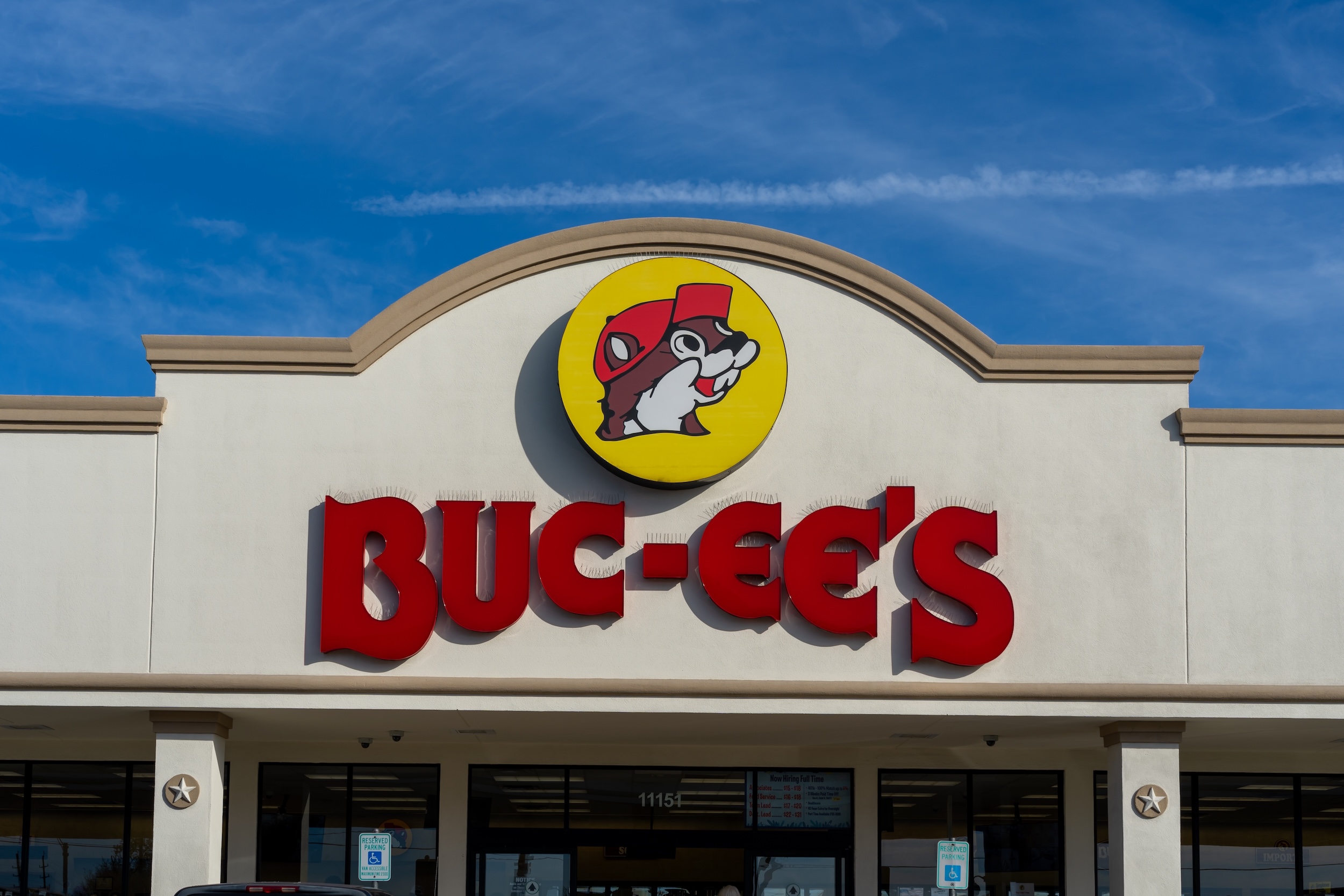
Top photo: Closeup of Buc-ee’s sign on a building in Houston, Texas, on February 14, 2022. Photo by JHVEPhoto, available via Shutterstock.